I'm calling the prototype for the machine discussed here "seymour". This post describes the first iteration of the hardware I'm using for research & experimentation.
Seymour Mark I Hardware
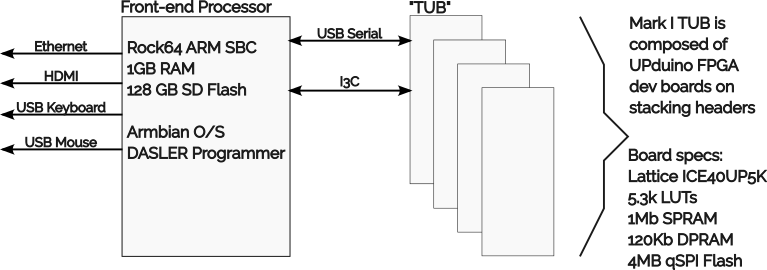
Parts List
* ROCK64 ARM SBC for front-end processor
* UPduino 3.1FPGA dev boards for TUB
* Stackable headers
* Breadboard
* Power supply
* 128 GB SD card
Why this hardware? Because it's what I have on-hand, and meets the minimum requirements.
The UPduino is a cheap and simple carrier for a Lattice FPGA that has an open-source toolchain. It should have enough LUTs to be useful for iterating on the DASLER programming environment and experimenting with the 3D FPGA interconnect as this board brings all the FPGA's pins out to the headers.
I could be wrong, but I think I can stack these using Arduino-style pass-through headers. Not the most electrically ideal interconnect but it should be enough to experiment.
I should be able to get a long way with a single FPGA (there's a lot of work to do!), so I don't need to figure out all the details for multiple FPGA's yet. Once I run out of LUTs on one board then I'll need to either switch to something larger or solve the interconnect.
The ROCK64 is a pretty weak SBC by today's standards, but all I need it to do for now is run the current Node.js-based version of the programmer's tool DASLER. It's capable of running Linux with a GUI, and maybe even a browser capable of running DASLER, which would mean the machine could function as a stand-alone workstation.